
A Quick Bit of Useful TriviaGALLERY2
Note 1: If you use the calculation results, please do so at your own risk. Sumida Corporation assumes no liability for any damages incurred.(計算結果をご使用になる場合は、自己責任においてご使用願います。また、発生した損害につきましては、一切の責任を負わないものとします)
Note 2: Unauthorized reproduction, copying, or reprinting of articles, photographs, illustrations, and calculation formulas on this site is strictly prohibited.
(掲載の記事・写真・イラスト・計算式などの無断複写・転載等を禁じさせて頂きます)
Note 3: This content is intended for use within Japan only.
(この内容は日本国内での使用のみを意図しています)
Note 4: Please use with caution. Thank you for your understanding.
(ご利用に当たり十分注意してください あらかじめご了承願います)
(1) What is "Stainless Steel"? 
Iron rusts. |
| (2) What is "SUS304"?
This is the most representative and widely used type of stainless steel. It is also frequently referred to as "18-8 stainless steel." |
|
(3) What is the difference between SUS304 and SUS304L?
While SUS304 and SUS304L contain the same amounts of chromium (Cr) and nickel (Ni), which directly impact corrosion resistance, they differ significantly in their carbon (C) content. |
|
(4) What is the difference between SUS304 and SUS316?
SUS304 and SUS316 are the two most prominent grades of austenitic stainless steel. |
|
(5) What are Martensite, Ferrite, and Austenite?
These terms refer to the classification of metal crystalline microstructures. |
|
(6) What are hardness and hardness symbols? These are standardized by JIS (Japanese Industrial Standards). The correspondence between hardness levels and symbols is as follows: (*) The unit for both "Tensile Strength" and "Spring Limit Value" is "N/mm2". (*) The unit for both "Tensile Strength" and "Spring Limit Value" is "N/mm2". (*) The unit for both "Tensile Strength" and "Spring Limit Value" is "N/mm2".
***** JIS G4313 Hardness (HV) (HV: Vickers Hardness Symbol [JIS Z 2244]) *****
***** Unit "N/mm2" ***** |
|
(7) What is the role of Chromium (Cr)?
The role of chromium (Cr) is, quite simply, "to prevent rust." |
|
(8) What are the types of stainless steel?
18-0 Stainless Steel (SUS430) |
|
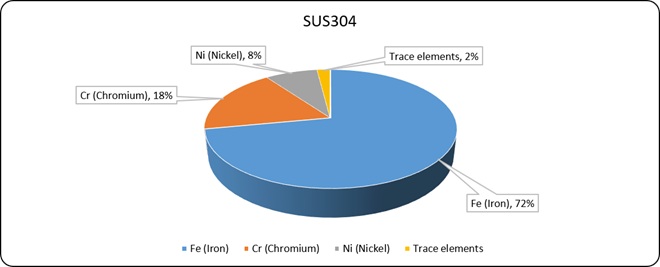
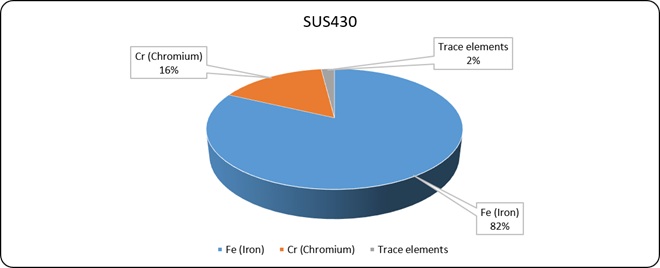
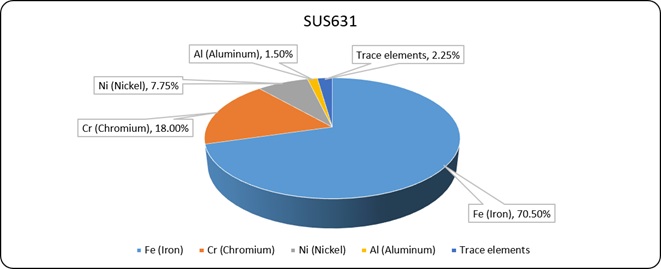
(9) What are the components of stainless steel? As shown in the diagrams below, mixing various metals with iron creates different types of stainless steel, each with its own unique characteristics. 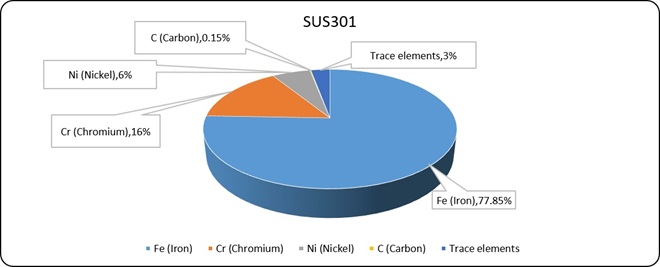
|
|
(10) What is "Weight per Millimeter"?
For example, let's say the weight per millimeter is 1 kg. You can calculate the mass (weight: kg) from the weight per millimeter. (You can calculate the unit weight of a coil.) (1) Enter half-width numbers into the "Coil Mass (Weight/kg)" and "Coil Width (mm)" fields. |
|
(11) What is "Specific Gravity Calculation"?
Here, we will explain using the example of stainless steel sheets. You can calculate the mass (weight: kg) of flat stainless steel spring sheets.(1) Enter half-width numbers into the "Thickness" and "Quantity" fields. (Specific Gravity: 7.93)(2) After entering the values, click [Calculate]. The calculation result (Mass: kg) will be displayed. (3) Click [Reset] to clear the entered values. Note 1: Please use the calculation results at your own risk. We assume no responsibility or liability for any damages that may occur. |
|
(12) What do "CSP" and "CP" stand for?
CSP: A symbol representing the manufacturing method. It stands for cold-rolled steel strips for springs. |
|
(13) What is "Camber"?
As shown in the figure below, it refers to the value of lateral curvature per 1 meter of length. Please also check out the helpful formulas: (13) "Formula to Find Camber Values" 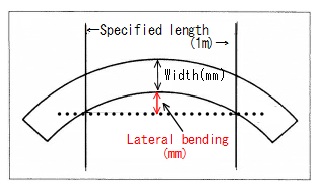
|
|
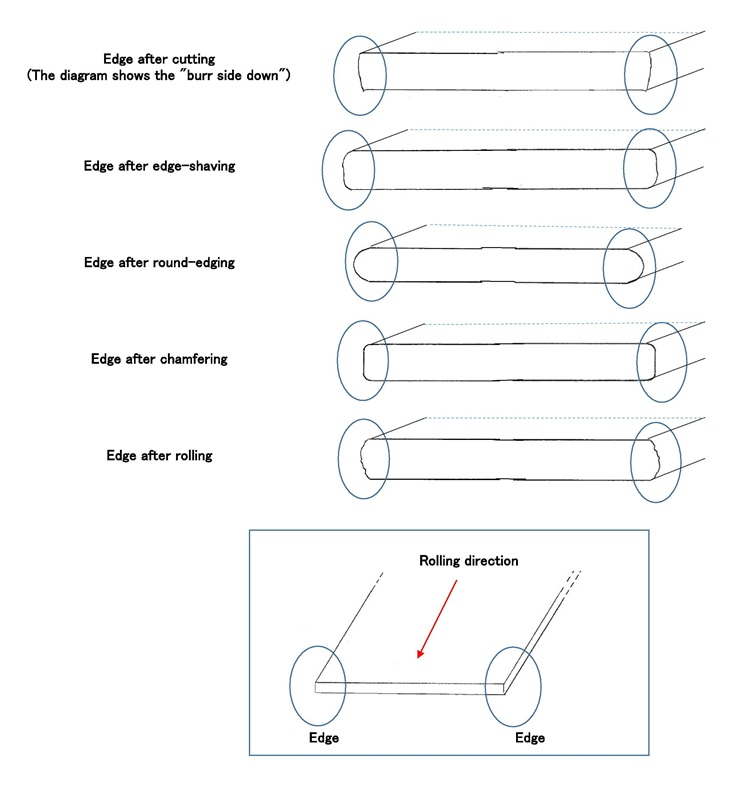
(14) What are "Edge Types"?
There are 5 types of edge finishes for products. (The diagram below is for illustrative purposes.)
 |
|
(15) What are "HV (Vickers)" and "HRC (Rockwell C)"?
The table below shows the approximate values of HRC converted from HV, and the approximate values of HV converted from HRC. 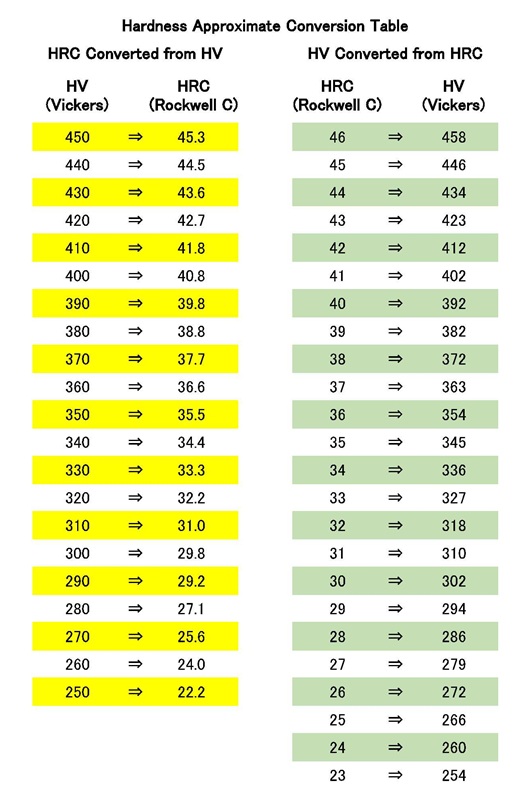 |
|
(16) What are "Burrs" and "Curl"? Why do they occur?
We will explain this by dividing it into two processing methods: Coil Slitting and Shearing.
First, let's look at the shape of stainless steel coils (spring steel) after slitting.
Figure 1: Conceptual front view of the slitting machine. Figure 2: Conceptual side view of the slitting machine. 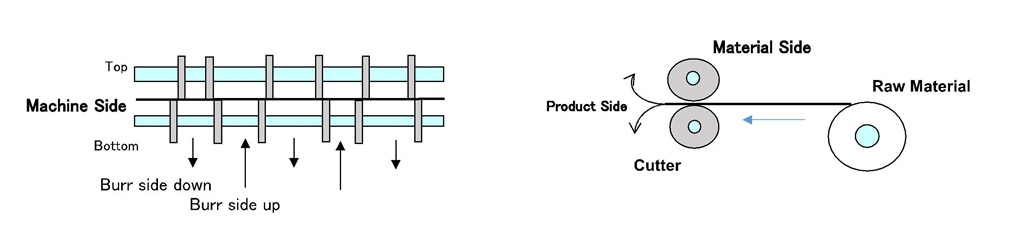
Figure 3: Illustration of the product coming out of the slitting machine. (Burrs are exaggerated for clarity.) 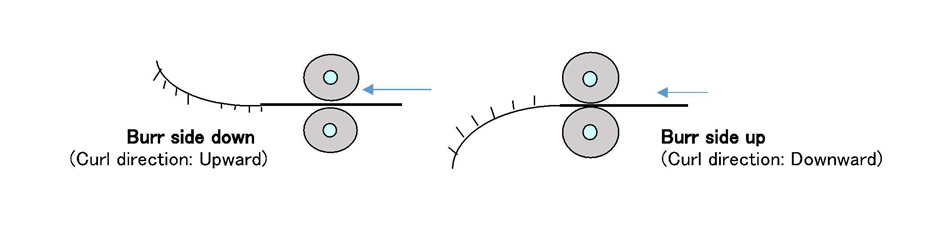
As shown above, during the slitting process, the cutters are set up (Figure 1), and when the material passes through (Figure 2), it emerges facing either upward or downward.
Figure 4: Conceptual front view of "Burr Up" and "Burr Down". (Burrs are exaggerated for clarity.) 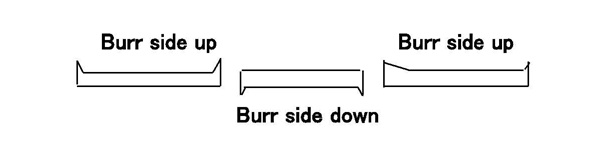
Examples of Terminology Usage:
Next, let's look at the shape after shearing (guillotine cutting).
Figure 5: Burr illustration for slit coils. Figure 6: Burr illustration for sheared sheets. 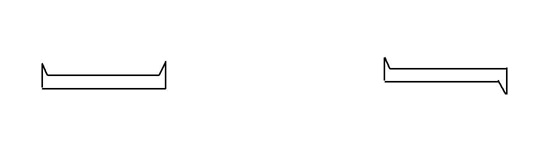
Because the upper blade of a shearing machine is angled, it is structured so that the blade descends starting from one end. 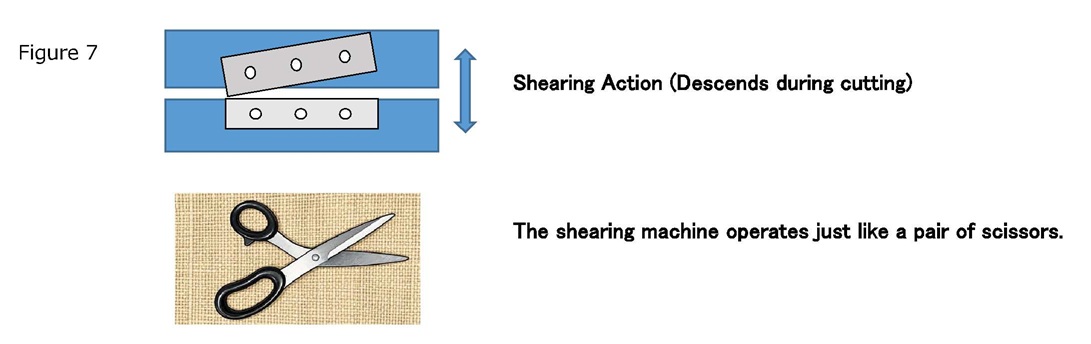
Figures 8 to 11 explain the actual cutting action of the "Shearing Machine Operation (Figure 7)".
Figure 8 illustrates the material (sheet metal) being held between the upper and lower blades. The clearance changes depending on the material thickness. 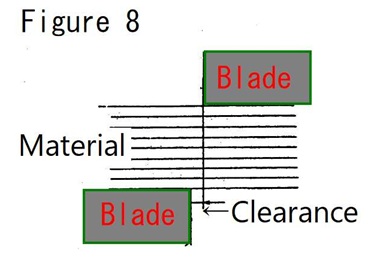
Figure 9 illustrates the upper blade descending and cutting (shearing) the material. 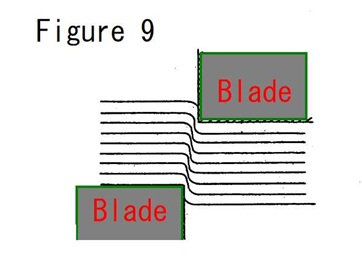
Figure 10 illustrates how cracks develop from both the upper and lower sides within the material during the cut. 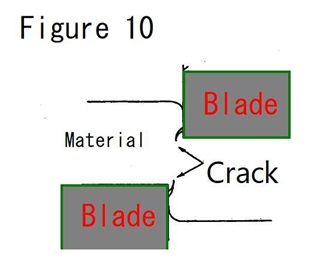
Figure 11 illustrates the material being separated (fractured) by the connecting cracks. 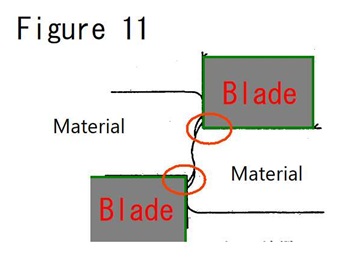 Figure 12 illustrates the cross-section of the cut edge. From top-left to bottom: "Rollover", "Shear Band", "Fracture Zone", and "Burr". On the right side, from top to bottom: "Burr", "Fracture Zone", "Shear Band", and "Rollover". 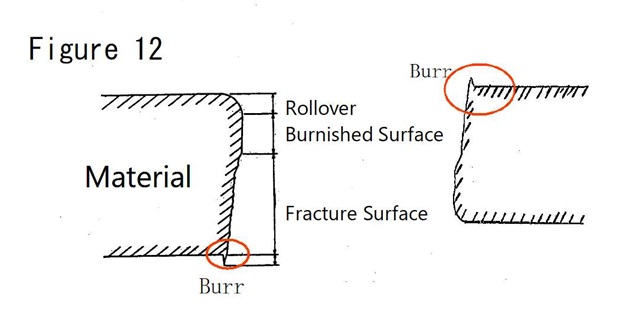 |
|
(17) What are "SUS304 2B Standard Sheet Weights and Thickness Tolerances"?
A sheet with a width of 1 m and a length of 2 m is commonly referred to as a "Meter Sheet."
SUS304 2B Meter Sheet (Width: 1,000 mm / Length: 2,000 mm) - Mechanical Properties
SUS304 2B Meter Sheet (Width: 1,000 mm / Length: 2,000 mm) - Thickness Tolerances & Weight per Sheet
|
|
(17) What are "SUS304 2B Standard Sheet Weights and Thickness Tolerances"?
A sheet with a width of 1 m and a length of 2 m is commonly referred to as a "Meter Sheet."
SUS304 2B Meter Sheet (Width: 1,000 mm / Length: 2,000 mm) - Mechanical Properties
SUS304 2B Meter Sheet (Width: 1,000 mm / Length: 2,000 mm) - Thickness Tolerances & Weight per Sheet
|
|
(18) What is a "Mill Sheet"?
A "Mill Sheet" is a document that certifies the quality and material grade of steel products. |
|
(19) What is the difference between "SUS316" and "SUS316L"?
Both SUS316 and SUS316L offer superior corrosion resistance compared to SUS304.
Element Guide: |
|
(20) What does "SK" stand for? "SK" is the abbreviation for carbon tool steel (in Japanese JIS standards). Its main applications include springs, mainsprings, knitting needles, automotive horns, measuring tapes, washers, and various other spring components. Generally, SK material undergoes heat treatment either before or after processing. It is widely used because of its excellent workability, hardenability, product performance, and more affordable price compared to stainless steel. The acronyms are unique blends of English and Japanese: ・SK (Carbon Tool Steel) stands for "S" from Steel, and "K" from Kougu (the Japanese word for tools). ・SKS (Alloy Tool Steel) stands for "S" from Steel, "K" from Kougu, and "S" from Special. SKS material is a type of tool steel enhanced by adding elements like tungsten, molybdenum, and chromium to base SK steel. As a result, it offers superior quench hardness and wear resistance compared to standard SK steel. Whether SK material can be used instead of SKS depends on the required wear resistance of the manufactured component. Therefore, for components subjected to high operational loads, it is generally safer to choose SKS material over SK material. * Types, Symbols, and Chemical Composition of Carbon Tool Steels (Unit: %)
Evolution of Grade Symbols: The current symbols represent the Carbon (C) content multiplied by 100 (Revised in 2000). SK2 → SK120 SK3 → SK105 SK4 → SK95 SK5 → SK85 SK6 → SK75 SK7 → SK65 |
|
(21) What are "RoHS, REACH, MSDS, and MSDS plus"? RoHS is a directive issued by the European Union (EU) that restricts the use of certain hazardous substances in electrical and electronic equipment. Under this directive, the content of specified hazardous substances must be kept at or below designated threshold values. The restricted substances and their maximum concentration limits are listed below: Lead: 1,000 ppm or less Mercury: 1,000 ppm or less Cadmium: 100 ppm or less Hexavalent Chromium: 1,000 ppm or less Polybrominated Biphenyls (PBB): 1,000 ppm or less Polybrominated Diphenyl Ethers (PBDE): 1,000 ppm or less (Reference: A "Directive" in the European Union requires member states to achieve a specific goal but leaves the choice of methods to each country. Therefore, it differs from a "Regulation," which has direct legal binding force in itself.) REACH is a regulation that mandates the registration of chemical substances and their usage conditions for companies that manufacture or import them into the European Union (EU) in quantities of 1 ton or more per year. MSDS (Material Safety Data Sheet)—also widely known as **SDS (Safety Data Sheet)**—is not directly linked to EU directives or regulations. It is a document used primarily to disclose information regarding the use and content of environmentally hazardous substances or specific chemical materials, along with necessary safety precautions for product handling. For example, it provides crucial instructions such as: ・What to do if the product is accidentally swallowed... ・Keep away from open flames or fire sources... ・Do not use alongside substance XX due to hazardous chemical reactions... Additionally, MSDS documents must include comprehensive profile information of the product's manufacturer. MSDS plus is a standardized information transmission sheet recommended by JAMP (Joint Article Management Promotion-consortium) to communicate details about chemical substances contained in products. This document is utilized to pass critical data along to customers, explicitly listing: ・The titles of relevant laws and regulations governing the components contained within the product. ・Whether regulated substances are present, their names, CAS numbers, exact concentrations, etc. JAMP appropriately manages chemical substance information contained in "articles" (a technical term for parts, components, and molded products). Recognizing that establishing and popularizing a smooth mechanism for disclosure and communication within the supply chain (the entire product flow from raw materials and parts procurement to manufacturing, inventory management, sales, and logistics) is vital for enhancing industrial competitiveness, 17 endorsing companies joined as founders to establish this cross-industry organization in September 2006. Samples of the information transmission sheets are shown below: 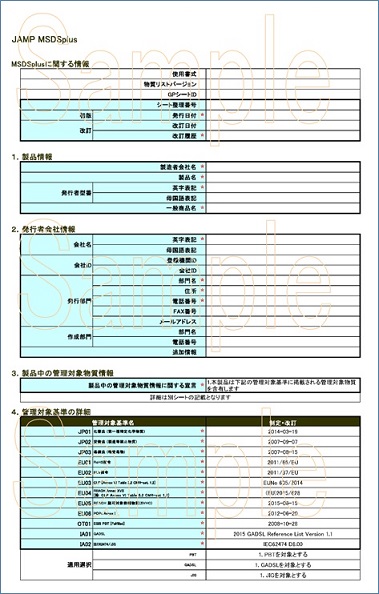 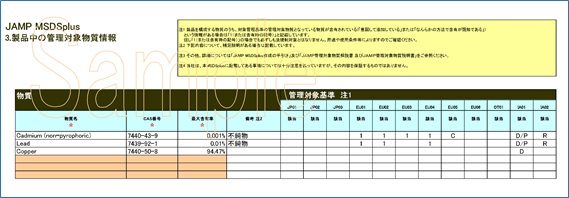 |
|
(22) What is "Plastic Film Coating (Surface Protective Sheet)"? Plastic film coating (surface protective sheet) is applied to metal materials to prevent surface scratches and damage. It is laminated onto the surface of materials (such as stainless steel coils or sheets) before they undergo metalworking processes like press stamping. It serves as a critical shield to safeguard the surface finish during fabrication. Once the processing is completed, the surface protective sheet is peeled off and removed. Below are the typical types of surface protective materials used: SG: A baked-on surface protective coating primarily composed of vinyl chloride. After baking, it cures into a film-like layer that can be peeled off easily. Its thickness generally ranges from 30 to 50 microns. SPV: A polyvinyl chloride (PVC) based sheet coated with a specialized pressure-sensitive adhesive. Once applied, it functions as an adhesive surface protection sheet. The sheet is laminated directly onto base metals (such as stainless steel). It can be removed smoothly without leaving residues or affecting the material. Its thickness is approximately 120 microns. SPH: A polyethylene (PE) based sheet coated with a specialized pressure-sensitive adhesive. Once applied, it functions as an adhesive surface protection sheet. The sheet is laminated directly onto base metals (such as stainless steel). It peels off easily and does not impact the raw material quality. Its thickness is approximately 60 microns. |
|
(23) What is "Etching"? Chemical etching is a fabrication process that uses chemical solutions to selectively erode and remove specific areas of a metal surface. Specifically, a master photo-tool pattern outlining the product shape is transferred onto the metal material, and the unmasked areas are chemically dissolved and processed using an acid or chemical solution. Unlike conventional machining or press stamping, this chemical process does not induce physical fabrication stress or create burrs. Therefore, it allows the finished product to maintain a perfectly flat appearance. Additionally, a thorough cleaning process is integrated as the final production step, ensuring highly clean and residue-free products. The diagram below illustrates this simple workflow. (Although simplified, this provides a general overview of the process.) 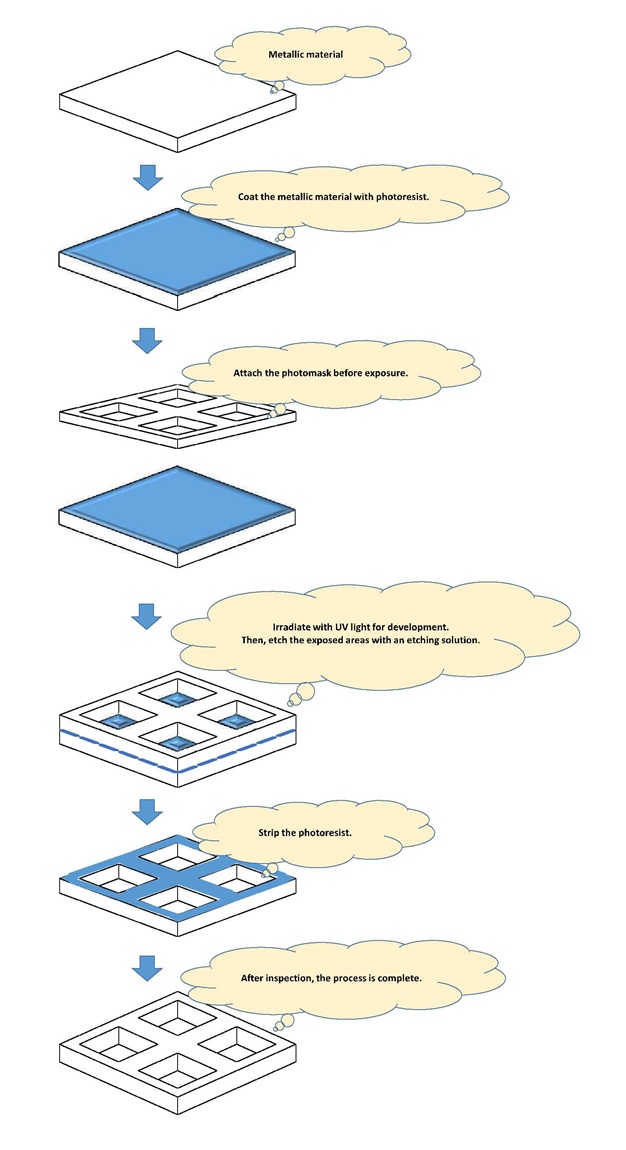 |
|
(24) What is "Rolling Direction"? Metal strips have a specific "Rolling Direction," which is also commonly referred to as the grain or roll direction. 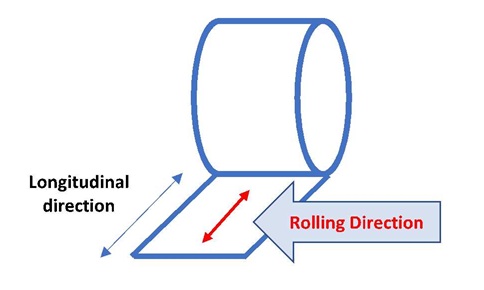 In precision metalworking, failure to account for this rolling direction can significantly negatively affect the results of subsequent bending processes. This is because the material develops stronger and weaker orientations relative to the bending direction. Therefore, parts must be nested and cut out with careful consideration of how they will be bent. If the cutting orientation is incorrect, cracking may occur along the bend lines. 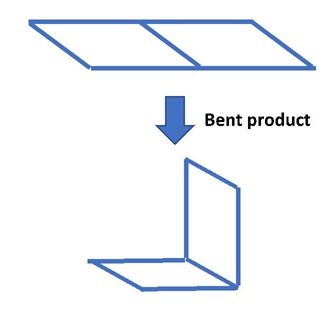 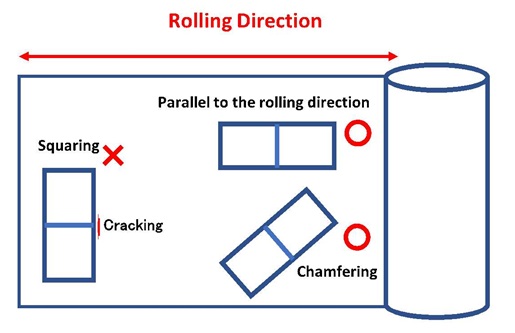 When manufacturing bent components like the one shown above, performing a "Perpendicular Cut" (bending parallel to the rolling direction) may cause cracks to form at the bend lines. Conversely, opting for a "Parallel Cut" (bending perpendicular to the rolling direction) or a "Diagonal Cut" will significantly mitigate the risk of cracking. 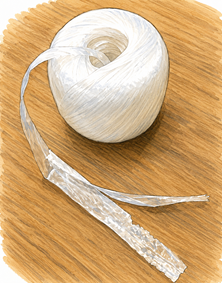 To use an extreme analogy, think of how a plastic ribbon easily tears lengthwise but resists tearing sideways. (Please rest assured, however, that stainless steel strips will never actually split apart like a plastic ribbon.) |
|
(25) What are "C-Bow" and "L-Bow"? C-Bow (Cross Bow) refers to a distortion where the material curves across its width, forming a gutter-like shape along its length. When the sheet is placed on a flat surface, its lateral edges lift upward.  L-Bow (Coil Set / Longitudinal Bow) refers to a condition where strong residual curvature remains along the length of the material. Instead of laying perfectly flat, the sheet retains the curled shape from its coiled state. This distortion is particularly common in high-hardness materials. *Please note that in our inquiries, this may be flagged as a "Coil Set Alert." As a manufacturer, we maintain strict quality controls and do not ship products with severe curl defects.  |
|
(26)If the page does not display properly, please try clearing your browser's cache.。 (Note: Please ensure that all checkboxes are cleared except for "Cached images and files.") (For Google Chrome, please refer to the diagram below. (Enlarged view)) 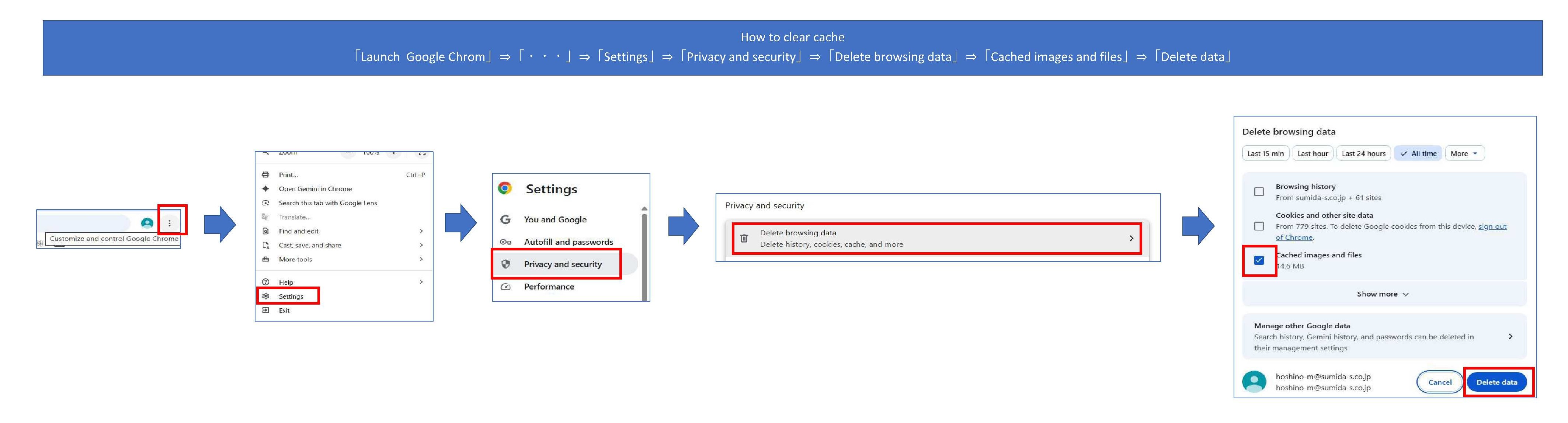
(For Microsoft Edge, please refer to the diagram below. (Enlarged view)) 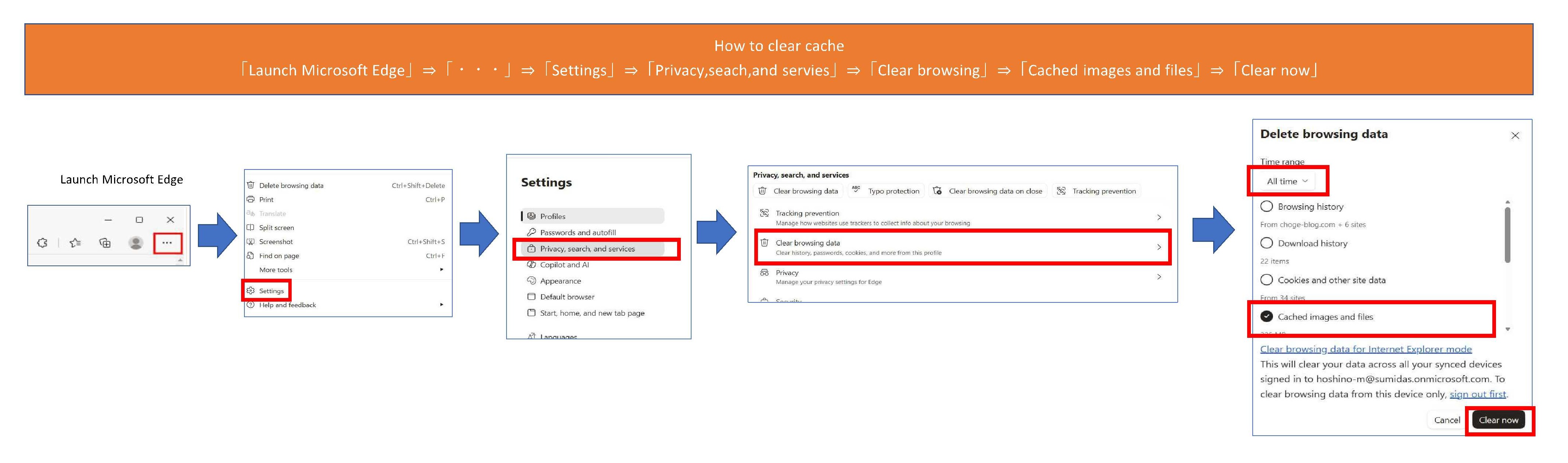
|