
Sumida Corporation

Handy Calculation FormulasGALLERY3

    Note 1: If you use the calculation results, please do so at your own risk. Sumida Corporation assumes no liability for any damages incurred.
    (計算結果をご使用になる場合は、自己責任においてご使用願います。また、発生した損害につきましては、一切の責任を負わないものとします)
    Note 2: Unauthorized reproduction, copying, or reprinting of articles, photographs, illustrations, and calculation formulas on this site is strictly prohibited.
    (掲載の記事・写真・イラスト・計算式などの無断複写・転載等を禁じさせて頂きます)
    Note 3: This content is intended for use within Japan only.
    (この内容は日本国内での使用のみを意図しています)
    Note 4: Please use with caution. Thank you for your understanding.
    (ご利用に当たり十分注意してください あらかじめご了承願います)
(1) Specific Gravity Calculation (Calculating the mass of stainless steel spring plates)
(2) Unit Weight per Millimeter (Calculating the unit weight of coils)
(3) Calculation to Determine Coil Outer Diameter
(4) Coil Splitting Calculation (2, 3, 4, 5 Splits) - For specific division details, please refer to (7), (8), (9), and (10).
(5) Specific Gravity Calculation Part 2 (Calculating sheet/plate mass with selectable specific gravity)
(6) Conversion/Calculation from HRC (Rockwell C) to HV (Vickers)
(7) Coil Splitting Calculation: 2-Split Edition
(8) Coil Splitting Calculation: 3-Split Edition
(9) Coil Splitting Calculation: 4-Split Edition
(10) Coil Splitting Calculation: 5-Split Edition
(11) Calculation of Stainless Steel Coil Length in Meters (m)
(12) Calculation of Coil Length in Meters (m) by Entering Specific Gravity
(13) Formula to Determine Camber/Lateral Bow Values
(14) Formula to Determine Converted Camber/Lateral Bow ValuesNEW

Handy Calculation Formulas
*** (1) Specific Gravity Calculation (Calculating the mass of stainless steel spring plates) ***

Calculate the mass (weight in kg) of stainless steel spring flat materials (plates/sheets).

(1) Please enter single-byte numbers into the Thickness and Quantity fields. (Specific Gravity: 7.93)
(2) After entering the values, click [Calculate]. The calculation result (Mass: kg) will be displayed.
(3) Click [Clear] to reset the values.

  SUS304, SUS301  H, 3/4H, 1/2H

 Thickness  × 320 × 1000

 Quantity  pcs


 Mass  kg (Rounded to 3 decimal places)


 Note: Please use these calculation results at your own risk. We shall not be held liable for any damages or losses arising from their use.

Handy Calculation Formulas
*** (2) Unit Weight per Millimeter (Calculating the unit weight of coils) ***

Calculate the unit weight of coils.

 (1) Please enter single-byte numbers into the Coil Mass (Weight / kg) and Coil Width (mm) fields.
 (2) After entering the values, click [Calculate].
 (3) The calculation result will be displayed in the Unit Weight (kg/1mm) field.
   (The calculation result is rounded to 3 decimal places.)
   (kg/1mm: Represents the weight per 1mm of width.)
 (4) Click [Clear] to reset the input values.

 Mass  kg

 Width   mm


 Unit Wt.  kg/1mm


 Note: Please use these calculation results at your own risk. We shall not be held liable for any damages or losses arising from their use.

Handy Calculation Formulas
*** (3) Calculation to Determine Coil Outer Diameter ***

Determine the outer diameter of a stainless steel coil.

(1) Please enter single-byte numbers into the Coil Width, Coil Weight (Mass), and Coil Inner Diameter fields.
   (Specific Gravity: 7.93)
(2) After entering the values, click [Calculate]. The calculation result (Outer Diameter: mm) will be displayed.
   The result will be shown in the Coil Outer Diameter field. The coil unit weight will also be displayed at the same time.
(3) Click [Clear] to reset the values.

 Steel Grade: SUS304, SUS301  Temper: H, 3/4H, 1/2H

 Coil Width   mm

 Coil Weight  kg

 Coil ID  mm (If a core is used, please add the core thickness)


 Coil OD  mm (Approximate value)

 Unit Weight (per mm)  kg/mm (The calculation result is rounded to 3 decimal places)


 Note: Please use these calculation results at your own risk. We shall not be held liable for any damages or losses arising from their use.

Handy Calculation Formulas
*** (4) Coil Splitting Calculation ***

Determine the equal division (longitudinal splitting) of a coil.

(1) Please enter single-byte numbers into the Specific Gravity, Wall Thickness, and Coil Inner Diameter fields.
(2) After entering the values, click [Calculate]. The calculation results will be displayed.
(3) Click [Clear] to reset the values.

 Specific Gravity      

 Wall Thickness (N)    mm

 Coil ID (X)  mm (If a core is used, please add the core thickness)


 Unit Weight (per mm)  kg/mm (The calculation result is rounded to 3 decimal places)


1

 2-Split (A)   mm (Approximate value)

 3-Split (B2)  mm (Approximate value)
 3-Split (B1)  mm (Approximate value)

 4-Split (C3)  mm (Approximate value)
 4-Split (C2)  mm (Approximate value)
 4-Split (C1)  mm (Approximate value)

 5-Split (D4)  mm (Approximate value)
 5-Split (D3)  mm (Approximate value)
 5-Split (D2)  mm (Approximate value)
 5-Split (D1)  mm (Approximate value)


 Note: Please use these calculation results at your own risk. We shall not be held liable for any damages or losses arising from their use.

Handy Calculation Formulas
*** (5) Specific Gravity Calculation Part 2 (Calculating sheet/plate mass with selectable specific gravity) ***

Calculate the mass (weight in kg) of "plates/sheets" for various steel grades.

(1) Please enter single-byte numbers and select the Specific Gravity, Thickness, Width, Length, and Quantity.
(2) After entering the values, click [Calculate]. The calculation result (Mass: kg) will be displayed.
(3) Click [Clear] to reset the values.

 Specific Gravity 

 Thickness  mm

 Width   mm

 Length  mm

 Quantity  pcs

      (Mass will display as 0 if specific gravity is not selected)

 Mass  kg (Rounded to 3 decimal places)


 Note: Please use these calculation results at your own risk. We shall not be held liable for any damages or losses arising from their use.

Handy Calculation Formulas
*** (6) Conversion/Calculation from HRC (Rockwell C) to HV (Vickers) ***

Determine the HV (Vickers) hardness value from an HRC (Rockwell C) value. (Approximate Value)

(1) Please enter the "HRC" value.
(2) After entering the value, click [Calculate]. The calculation result (HV) will be displayed.
  Please use the calculation results as a reference (approximate value).
(3) Click [Clear] to reset the values.

 HRC 


 HV   (Rounded to 3 decimal places. Please use as a reference/approximate value.)


 Note: Please use these calculation results at your own risk. We shall not be held liable for any damages or losses arising from their use.

The table below displays the "Approximate HRC values from an HV perspective" and "Approximate HV values from an HRC perspective."
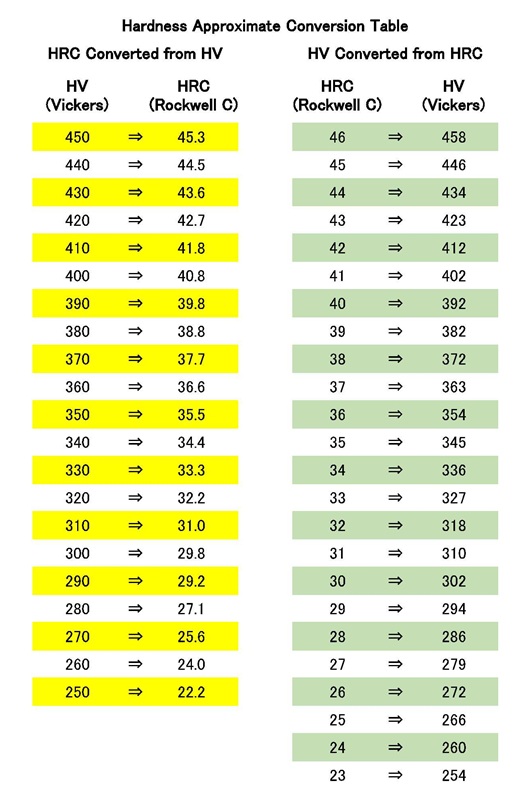
Please use it as an approximate conversion chart.
Reference: The HRC hardness testing method uses a diamond indenter or a ball indenter. First, a preliminary test force (*1) is applied, followed by an additional test force (*2). When the load is returned to the preliminary test force, the difference in indentation depth (h) between the two applications of the preliminary test force determines the hardness value based on the HR definition formula (*3).
  *1 Preliminary Test Force: 98.07 N (10 kgf)
  *2 Total Test Force: 1471.0 N (150 kgf)
  *3 Definition Formula: HR = 100 - (h ÷ 2)
  ***** Excerpt from JIS Z 2245 *****

Reference: The Vickers hardness testing method uses a diamond square-based pyramid indenter with a face angle of 136 degrees. It calculates the value based on the test force applied to form an indentation on the test surface and the surface area derived from the diagonal length of the indentation.
  ***** Excerpt from JIS Z 2244 *****

HV HRC

Handy Calculation Formulas
*** (7) Coil Splitting Calculation: 2-Split Edition ***

Determine the "nearly equal division" of a coil.
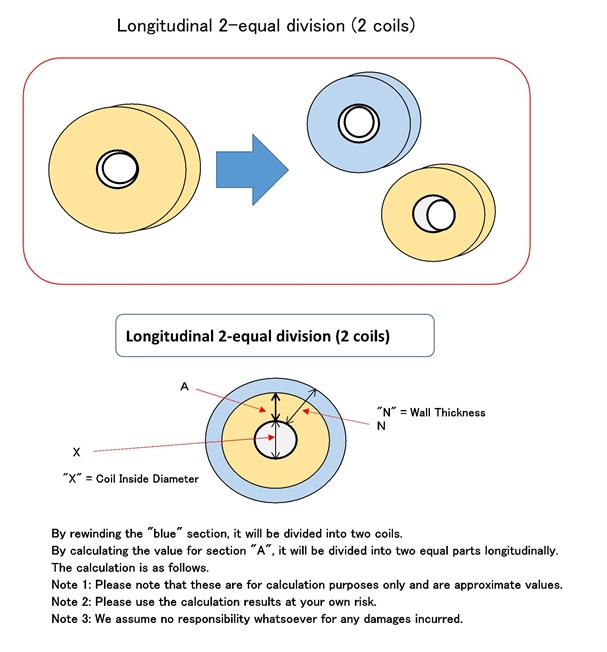
1

   (1) Please enter single-byte numbers into the Specific Gravity, Wall Thickness, and Coil Inner Diameter fields.
   (2) After entering the values, click [Calculate]. The calculation results will be displayed.
   (3) Click [Clear] to reset the values.

       Specific Gravity 
      Wall Thickness (N)  mm
        Coil ID (X)  mm (If a core is used, please add the core thickness)


 Unit Weight (per mm)  kg/mm (The calculation result is rounded to 3 decimal places)

     2-Split (A)  mm (Approximate value measured from the coil ID outer surface / 1st coil)
     The remaining portion will be the second coil. This divides them nearly equally.


 Note: Please use these calculation results at your own risk. We shall not be held liable for any damages or losses arising from their use.

Handy Calculation Formulas
*** (8) Coil Splitting Calculation: 3-Split Edition ***

Determine the "nearly equal division" of a coil.
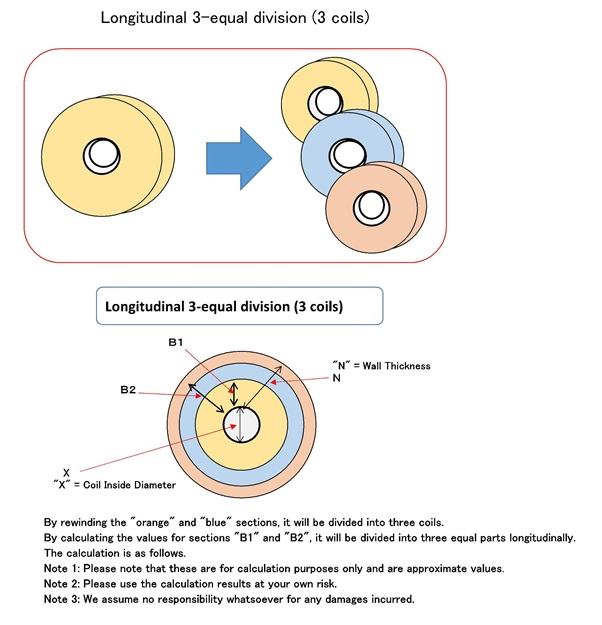
1

   (1) Please enter single-byte numbers into the Specific Gravity, Wall Thickness, and Coil Inner Diameter fields.
   (2) After entering the values, click [Calculate]. The calculation results will be displayed.
   (3) Click [Clear] to reset the values.

       Specific Gravity 
      Wall Thickness (N)  mm
        Coil ID (X)  mm (If a core is used, please add the core thickness)


 Unit Weight (per mm)  kg/mm (The calculation result is rounded to 3 decimal places)

   3-Split (B2)  mm (Approximate value measured from the coil ID outer surface / 1st coil)
   3-Split (B1)  mm (Approximate value measured from the coil ID outer surface / 2nd coil)
   The remaining portion will be the third coil. This divides them nearly equally.


 Note: Please use these calculation results at your own risk. We shall not be held liable for any damages or losses arising from their use.

Handy Calculation Formulas
*** (9) Coil Splitting Calculation: 4-Split Edition ***

Determine the "nearly equal division" of a coil.
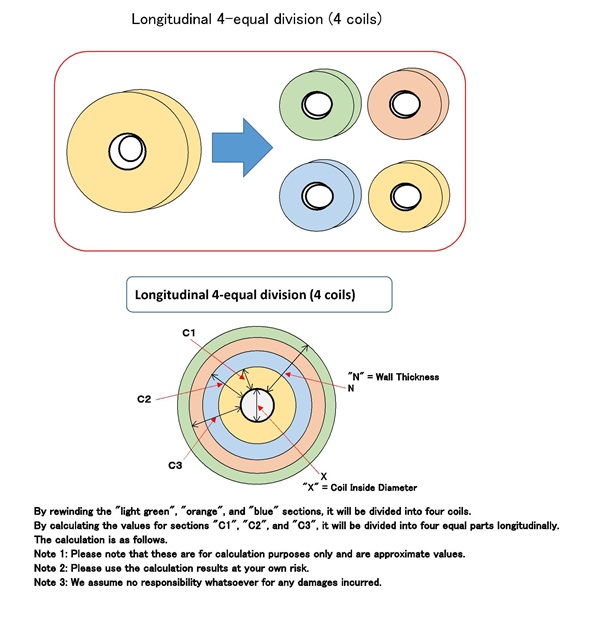
1

   (1) Please enter single-byte numbers into the Specific Gravity, Wall Thickness, and Coil Inner Diameter fields.
   (2) After entering the values, click [Calculate]. The calculation results will be displayed.
   (3) Click [Clear] to reset the values.

       Specific Gravity 
      Wall Thickness (N)  mm
        Coil ID (X)  mm (If a core is used, please add the core thickness)


 Unit Weight (per mm)  kg/mm (The calculation result is rounded to 3 decimal places)

   4-Split (C3)  mm (Approximate value measured from the coil ID outer surface / 1st coil)
   4-Split (C2)  mm (Approximate value measured from the coil ID outer surface / 2nd coil)
   4-Split (C1)  mm (Approximate value measured from the coil ID outer surface / 3rd coil)
   The remaining portion will be the fourth coil. This divides them nearly equally.


 Note: Please use these calculation results at your own risk. We shall not be held liable for any damages or losses arising from their use.

Handy Calculation Formulas
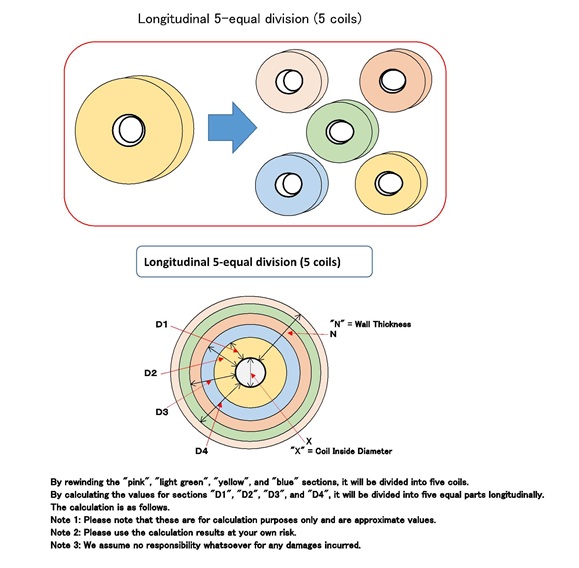
*** (10) Coil Splitting Calculation: 5-Split Edition ***

Determine the "nearly equal division" of a coil.
1

   (1) Please enter single-byte numbers into the Specific Gravity, Wall Thickness, and Coil Inner Diameter fields.
   (2) After entering the values, click [Calculate]. The calculation results will be displayed.
   (3) Click [Clear] to reset the values.

       Specific Gravity 
      Wall Thickness (N)  mm
        Coil ID (X)  mm (If a core is used, please add the core thickness)


 Unit Weight (per mm)  kg/mm (The calculation result is rounded to 3 decimal places)

   5-Split (D4)  mm (Approximate value measured from the coil ID outer surface / 1st coil)
   5-Split (D3)  mm (Approximate value measured from the coil ID outer surface / 2nd coil)
   5-Split (D2)  mm (Approximate value measured from the coil ID outer surface / 3rd coil)
   5-Split (D1)  mm (Approximate value measured from the coil ID outer surface / 4th coil)
   The remaining portion will be the fifth coil. This divides them nearly equally.


 Note: Please use these calculation results at your own risk. We shall not be held liable for any damages or losses arising from their use.

Handy Calculation Formulas
*** (11) Calculation of Stainless Steel Coil Length in Meters (m) ***

Determine the total length of a stainless steel coil in meters (m).

(1) Please enter single-byte numbers into the Coil Thickness, Coil Width, and Coil Weight (Mass) fields.
   (Specific Gravity: 7.93)
(2) After entering the values, click [Calculate]. The calculation result (Length: m) will be displayed.
   The result will be shown in the Meter Count field. The coil unit weight will also be displayed at the same time.
(3) Click [Clear] to reset the values.

 Steel Grade: SUS304, SUS301

 Coil Thickness  mm

 Coil Width  mm

 Coil Weight  kg


 Meter Count  m (Approximate value)

 Unit Weight (per mm)  kg/mm (The calculation result is rounded to 3 decimal places)


 Note: Please use these calculation results at your own risk. We shall not be held liable for any damages or losses arising from their use.

Handy Calculation Formulas
*** (12) Calculation of Coil Length in Meters (m) by Entering Specific Gravity ***

Determine the total length of a coil in meters (m).

(1) Please enter single-byte numbers into the Specific Gravity, Coil Thickness, Coil Width, and Coil Weight (Mass) fields.
(2) After entering the values, click [Calculate]. The calculation result (Length: m) will be displayed.
   The result will be shown in the Meter Count field. The coil unit weight will also be displayed at the same time.
(3) Click [Clear] to reset the values.

 Specific Gravity  

 Coil Thickness  mm

 Coil Width  mm

 Coil Weight  kg


 Meter Count  m (Approximate value)

 Unit Weight (per mm)  kg/mm (The calculation result is rounded to 3 decimal places)


 Note: Please use these calculation results at your own risk. We shall not be held liable for any damages or losses arising from their use.

Handy Calculation Formulas
*** (13) Formula to Determine Camber/Lateral Bow Values ***

Determine the camber/lateral bow value (mm). (Conversion formula per 1m)

As shown in the diagram below, camber/lateral bow refers to the "camber value relative to a length of 1m."
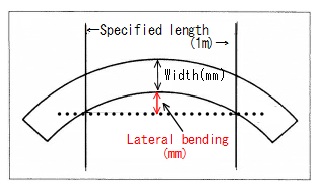
This value applies to products where the ratio of width (w) to thickness (t), "w/t", is 10 or greater.
However, depending on the agreement between the delivery parties, a tolerance of up to 1/2 of the camber (mm) value may be specified.
  ***** Excerpt from JIS G4313 *****

Camber / Lateral Bow

Width (mm)
10mm to
less than 20mm
20mm to
less than 40mm
40mm to
less than 80mm
80mm
or more
Camber (mm)
8mm or less
6mm or less
3mm or less
1mm or less

(1) Please enter single-byte numbers into the Thickness, Width, Length, and Target Value fields.
(2) After entering the values, click [Calculate]. The calculation result (Allowable Camber Value: mm) will be displayed.
(3) Click [Clear] to reset the values.

 Thickness (t)  mm

 Width (w)  mm

 Length    mm

 Target Value  mm (Camber Target Value) Please enter the value per 1m from the table above.


 Note: Width (w) ÷ Thickness (t) = ÷ =  (Applicable when the ratio is 10 or greater)

 The allowable camber value for a length of mm is mm (Approximate value)


 Note: Please use these calculation results at your own risk. We shall not be held liable for any damages or losses arising from their use.

Handy Calculation Formulas
*** (14) Formula to Determine Converted Camber/Lateral Bow Values ***

Determine the converted camber/lateral bow value (mm). (Converted based on a standard of 1,000mm (1m))

The values in the table below serve as calculation examples.
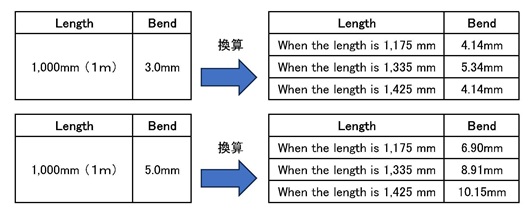
*The target camber specifications are set to "3.0mm or less per 1,000mm (1m)" and "5.0mm or less per 1,000mm (1m)."

Camber Conversion Chart

(1) Please enter single-byte numbers into the Length field, and select the Target Value.
(2) After entering the values, click [Calculate]. The calculation result (Converted Camber Value: mm) will be displayed.
(3) Click [Clear] to reset the values.

 Length   mm

 Target Value 


 The converted camber value is mm


 Note: Please use these calculation results at your own risk. We shall not be held liable for any damages or losses arising from their use.